
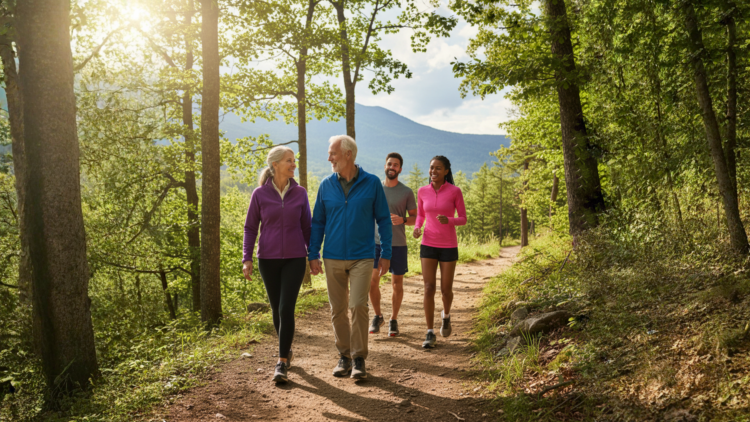
New research puts hard numbers on one of health science’s most enduring promises — and the math is remarkable.
Here’s a number worth sitting with for a moment — then immediately getting up and walking around the block to celebrate: five years. That’s how much longer you could live, according to a study published in the British Journal of Sports Medicine, if you matched the daily activity levels of the most physically active segment of the American population. No gym membership required. No spandex. No pedaling for miles with a bike seat wedged between your butt cheeks. Just walking.
Key Takeaways
- Walking at the activity level of the most active Americans could extend your lifespan by at least five years — and up to 11 years for the least active individuals.
- For every hour walked, the least active adults can expect to gain approximately six hours of life expectancy.
- The biggest benefits go to the least active people — small increases in daily movement yield proportionally large health gains.
- There is no age cutoff. Starting a walking habit at 60, 70, or beyond still delivers meaningful improvements in health and longevity.
- Walking improves cardiovascular health, bone density, mood, cognitive function, and reduces the risk of heart attack, stroke, and hip fracture.
- The wins are often invisible — the diseases that never develop, the events that never occur. That’s not a bug in the data. That’s the point.
For the least active quarter of Americans over 40, the math gets even more interesting. Every hour of walking they add to their routine could return roughly six hours of life expectancy. That is, to put it mildly, an extraordinary return on investment for something you already know how to do.
The study, which used national health data and Census information, found that the top 25% of Americans in daily physical activity generate the equivalent of about 160 minutes of walking per day at close to 3 miles per hour. For the most sedentary Americans, matching that level could add up to 11 additional years of life. Eleven years. That’s a lot of summer vacations.
Just Hoof It
One of the more refreshing aspects of this research — and exercise science in general lately — is the growing consensus that intensity matters less than consistency. Ryan Glatt, a senior brain health coach at the Pacific Neuroscience Institute, put it plainly: “The benefits are most significant for individuals who are inactive, as even small increases in physical activity substantially reduce the risk of noncommunicable diseases and premature death.”
In other words, the person who goes from zero to a 20-minute daily walk has more to gain, proportionally, than an already-active person logging their fifth run of the week. The good news finds the people who need it most.
Glatt also made a point worth underscoring for anyone who’s ever felt intimidated by fitness culture: walking is uniquely accessible. “Walking differs from running or weight training in its lower intensity and accessibility, making it particularly effective for sedentary individuals. While running and weight training target different physiological systems, walking is easier to maintain and provides significant life expectancy benefits without the barriers often associated with more intense exercises.”
Translation: You don’t need to suffer to benefit.
But Wait — Is It Too Late?
For anyone reading this and thinking, “Sure, but I’m 60. That ship has sailed” — it hasn’t. Not even close.
Dr. Christopher Schneble, a sports medicine physician at Yale Medicine, offered a perspective that’s both scientifically grounded and genuinely encouraging. “There is no specific cutoff age for the benefits of walking,” Glatt said. Even individuals who begin walking later in life can see meaningful improvements in health and life expectancy, though the extent of the benefit may depend on pre-existing health conditions.
Schneble added something that reframes the whole conversation about aging and exercise: “I think it will be hard to ever personally recognize the benefits, because in a sense they would be events that never happened — things like a heart attack, stroke, or a hip fracture that never occurred.”
That’s a profound way to think about preventive health. The wins are invisible — the illness that didn’t develop, the fall that didn’t happen, the years that quietly accumulated. Walking doesn’t announce itself with a trophy. It just works.
“As we get older, our reserve tends to decrease, as does our maximal achievable fitness level,” Schneble continued. “If we condition ourselves, we can place ourselves at a much better level of health that will better shield us from some of the modifiable perils that unavoidably come with aging. Just because the decision to focus on improving one’s health didn’t come at the perfect time to maximize things, that doesn’t mean there isn’t still substantial benefit to be gained.”
How Does Walking Actually Add Years to Your Life?
The mechanism isn’t magic, but it’s close. Regular walking creates a cascade of cardiovascular improvements — better blood pressure, improved cholesterol, reduced body fat — that collectively ease the burden on your heart. And since cardiovascular disease remains the leading cause of mortality in older adults, those improvements translate directly into reduced mortality risk.
Schneble explained it this way: “Engaging in physical activity can result in improved preservation of bone density, improved strength, reduced body fat, and better cardiovascular health. It can also lead to improvements in both mood and cognitive function. Improving things like heart rate and blood pressure can all help decrease how hard the heart must work to pump blood throughout the body, which in return is protective.”
The domino effect is real. Stronger bones, sharper cognition, better mood, healthier heart — all from the same activity your ancestors did simply to get from one place to another. We’ve somehow made it complicated, but it isn’t.
FAQ
How much walking do I actually need to do?
The study found that the most active Americans average the equivalent of about 160 minutes of walking per day — but that doesn’t mean you need to hit that target immediately. The key finding is that any increase in daily steps delivers measurable benefits. Even 20-30 minutes a day is a powerful starting point.
Is brisk walking better than a casual stroll?
Pace does matter, but not as much as frequency and duration. Faster walking has been linked to additional cardiovascular benefits, but a consistent moderate-paced walk beats an occasional sprint every time. Find a pace you can sustain and build from there.
What if I have health conditions that make walking difficult?
Both experts cited in the study emphasized that the benefits hold even for people with pre-existing health conditions, though the extent may vary. If you have specific concerns, a quick conversation with your doctor can help you find an appropriate starting point. The default answer is almost always: start small and build gradually.
Does the research apply outside the US?
The study drew on American health data, which is a noted limitation. However, the broader relationship between physical activity, cardiovascular health, and longevity is one of the most consistently replicated findings in all of health science, across countries and populations. The specific numbers may vary; the direction doesn’t.
What about running, cycling, or other exercise? Is walking really enough?
Walking is uniquely positioned because of its accessibility and sustainability. For the majority of adults — particularly those who are currently sedentary — walking is not a consolation prize. It’s the right tool for the job. More intense exercise offers additional benefits, but walking delivers an impressive return on its own terms.
I sit most of the day for work. What’s realistic?
Start with what’s achievable: a 10-minute walk after lunch, a slightly longer route to the parking lot, a walk around the block after dinner. The research is consistent that breaking up sedentary time matters, and that cumulative daily steps — however you accumulate them — deliver real benefits. Perfection isn’t the goal. Progress is.
The bottom line? The science isn’t subtle here. Walking is one of the most powerful, accessible, and underutilized health interventions available to almost every adult on the planet. It costs nothing, requires no special equipment, and — as this research makes clear — the returns compound in ways that show up where it matters most: in years of healthy, active life. So close this tab, lace up, and go get some.
Source: British Journal of Sports Medicine / Medical News Today, November 2024